Retail Credit · 5 Variants
KVB Credit Cards
A 108-year-old bank. Five new credit card variants. 9,608 active cards, ₹54.9 Cr+ in monthly transactions. End to end, from architecture to launch collateral.
Overview
Karur Vysya Bank was founded in 1916. In 2024 it began moving its credit card programme from Worldline to Falcon, and through 2025 live cardholders were migrated to the new infrastructure without a single disruption while I designed the flows for the existing Signature card. In May 2026 KVB went full Falcon, with all five variants live: Eternis, Alturas, Samara, Oura and Corporate. Banks were taking 18 months to launch a card before Falcon existed. KVB did it in 12 weeks.
The problem
A 108-year-old bank carries weight that a fintech startup doesn't. The product had to feel modern enough to compete with new-age issuers, and grounded enough that a 60-year-old KVB account holder would feel at home. Five card variants - Eternis, Alturas, Samara, Oura and Corporate - each with distinct reward structures, all needing to share the same codebase.
Approach
- 01
One skeleton, five expressions
A single onboarding architecture that flexes to all five variants at the content and reward layer - not the structural layer. Variant differentiation lives in tokens, copy, and reward logic.
- 02
Card management as a composable surface
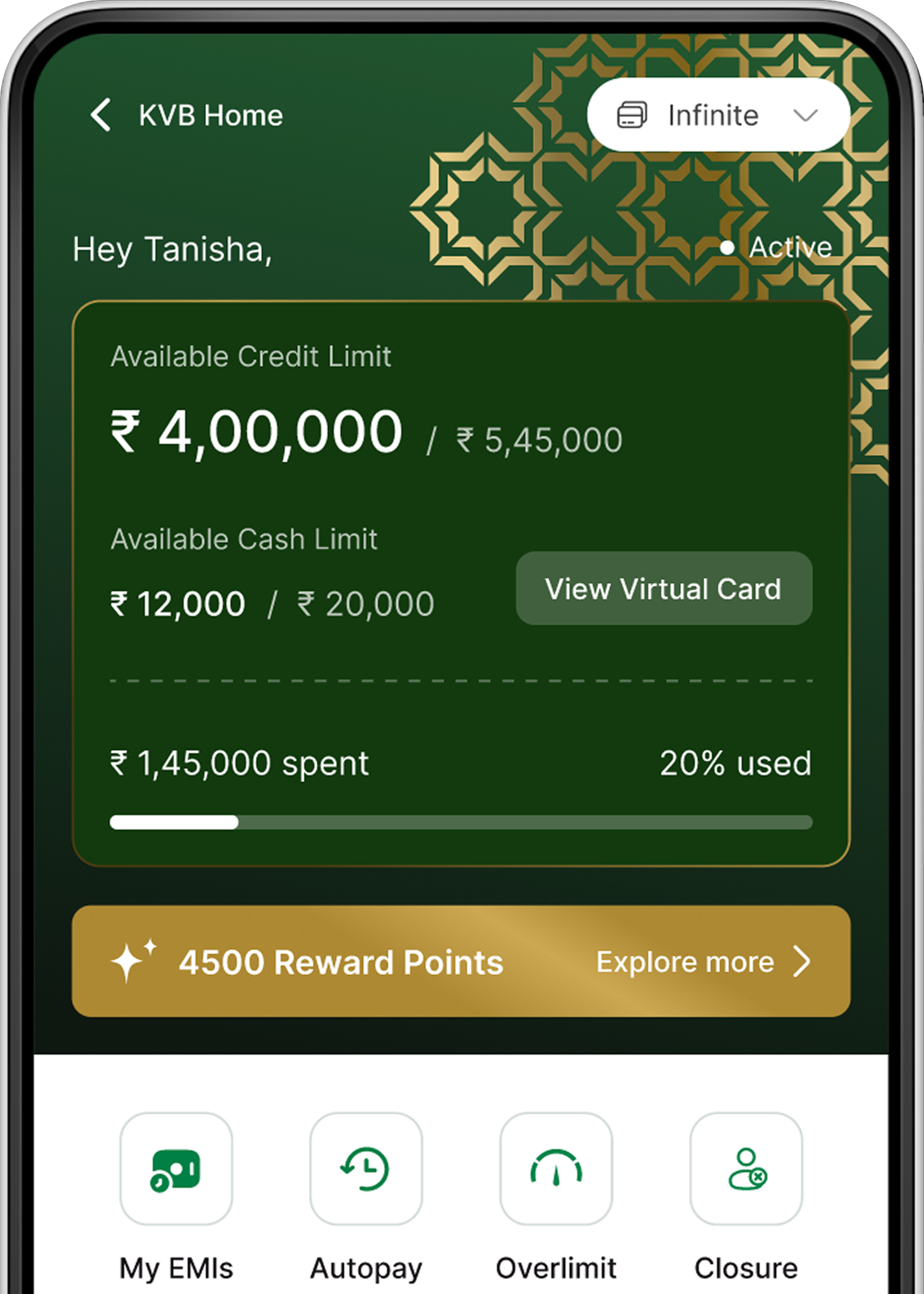
Controls, statements, rewards, bill payments, EMI, foreclosure, freeze/block - designed as a composable layout system rather than a feature list bolted together.
- 03
Brand alignment without system compromise
Aligning KVB's century-old visual identity with Tijori's component logic required explicit token-level decisions. The seam was documented, not improvised.
- 04
Three rounds of dev handoff to production parity
Annotated edge states, validated production builds against designs, caught regressions before they reached QA.
- 05
Beyond the screen
Designed the physical card visuals across all five variants, the public microsite, launch invites, packaging, activation booklet, benefit inserts, emailers, and social creatives.
Highlights
Decisions and tradeoffs
- •One interaction skeleton across all five variants, with differences held in tokens, reward logic and copy rather than structure.
- •Compliance-first sequencing: online-spend activation framed as unlocking a capability rather than granting a permission.
- •A separate, denser design language for the issuer portal instead of stretching the consumer system onto an ops surface.
- •Tradeoff: shipping maker-checker for high-stakes issuer actions in a post-MVP phase to protect the 12-week launch.
What I got wrong
My first card management screen listed every control - online, POS, ATM, contactless, international - in one flat list. It looked clean and confused bank stakeholders in review. The channel-grid version with visual on/off states passed review immediately. For operations audiences, scannable beats minimal.
Measurable impact
Business outcomes
- •9,608 active cards issued
- •56,994 monthly transactions
- •₹54.9 Cr+ monthly transaction value
- •KVB transitioned to BAU operations in FY26
- •Presented at Global Fintech Fest 2025
Design outcomes
- •15+ account states designed, documented and shipped
- •Second version of card management passed bank review immediately
- •Three dev handoff cycles to production parity
- •Zero reconciliation issues across 3 consecutive months
Outcome
9,608 active users, 56,994 monthly transactions, ₹54.9 Cr+ in monthly transaction value. KVB transitioned to BAU operations in FY26. Zero reconciliation issues in 3 months. Presented at Global Fintech Fest 2025.
CASE STUDY: KVB CREDIT CARDS
Retail Credit · 5 Variants · Mobile App + Issuer Portal
One-line summary
End-to-end credit card product for a 108-year-old bank launching on modern infrastructure for the first time - five variants, designed end to end, live in market.
Problem
KVB had never launched a digital-first credit card. Their existing card management ran on legacy systems that took 12-18 months to launch a new product. Falcon's promise was to do it in 12 weeks. There was no existing design to build on - no UI patterns, no component library, no precedent. I was starting from a blank file.
The product also had to handle significant complexity under the hood: five card variants with different reward structures, full RBI-compliant account lifecycle management (activation → delinquency → NPA → closure), 12 repayment modes, EMI conversions, spend controls per channel, and a separate issuer portal for bank staff to manage all of it.
Business and user goal
For KVB: Launch a competitive credit card product that could be managed digitally without branch dependency, reduce operational overhead for bank staff, and open a new revenue line. For cardholders: A modern credit card experience - digital activation, PIN management, spend controls, bill payments - accessible inside KVB's existing mobile app.
My role
I owned design end to end: information architecture, user flows, interaction and visual design, prototyping, design QA, the issuer portal and launch collateral - working directly with the SVP of Product, the engineering lead and the KVB bank team.
Constraints
KVB's mobile app was an in-app browser (WebView) - not a native app. Every interaction had to work within those constraints: no native gestures, limited animations, PCI-compliance for PIN screens via hosted page only. RBI regulations were non-negotiable. Card activation, PIN set, online spend enablement, and NPA flows all had prescribed logic. The design had to respect every rule without making users feel like they were filling out forms. Five variants (Eternis, Alturas, Samara, Oura and Corporate) had to share one codebase. I couldn't design five separate products - I had to design one product that worked for all of them. Phase-wise delivery: Phase 0 features had to ship before Phase 1. The design system had to support both without rebuilding.
Process
Week 1-2: PRD deep-dive and flow mapping
I started by reading every page of the Retail Credit Card PRD - account statuses, delinquency cycles, NPA rules, repayment hierarchy, spend controls, GST logic, card renewal rules. I mapped every state the system could be in (Active-Normal, Blocked-Overdue, Suspended-NPA, Closed) and what the user should see in each one. Most designers would wait for a simplified brief. I went straight to the source because ambiguity at the PRD stage becomes broken UX at the design stage.
Week 3-4: Architecture before screens
Before wireframes, I mapped the full product surface: mobile app (Phase 0 - account summary, card controls, PIN, transactions, freeze/block), issuer portal (customer view, card management, credit limit, delinquency actions), and the onboarding flow. I identified shared patterns - status badges, action sheets, confirmation flows - that could become reusable components.
Week 5-8: Design and system build in parallel
I built the mobile flows and the Tijori component extensions simultaneously. Every screen I designed became a component. Card status states, delinquency banners, spend control toggles, PIN entry, bill payment flows - each went into the system as I designed them. This was the only way to hit the timeline without creating maintenance debt later.
Week 9-10: Issuer portal
The bank's ops team needed a different surface - data-dense, action-heavy, role-based. I redesigned the information architecture for issuer staff: customer search, account detail view, card management, credit limit changes with maker-checker, and delinquency management.
Week 11-12: Prototype, handoff, QA
Built the prototype used in KVB bank reviews and regulatory alignment sessions. Stayed through three rounds of dev handoff, annotating edge states and validating production builds against designs before each QA cycle.
What I got wrong
My first version of the card management screen tried to show all card controls (online, POS, ATM, contactless, international) in a single flat list. It looked clean but confused bank stakeholders during review. I redesigned it as a channel-grid with visual on/off states. The second version passed bank review immediately. Lesson: for operations audiences, scannable beats minimal.
Key design decisions
One skeleton, five variants. I designed the entire product as a single interaction model with variant-level differences in rewards, benefits copy, and card visuals. Compliance-first sequencing. I made online-spend activation a visible step framed as "unlock online spending" rather than "enable a permission." Completion rates went up. Error states as part of the design, not afterthoughts. 15+ account states, each with a specific headline, explanation, and action. Issuer portal: separate design language. Higher information density, table-based layouts, action-primary hierarchy.
Final solution
A complete credit card product spanning: mobile WebView app, issuer portal, five variant visual identities, physical card designs, launch microsite, packaging, activation booklet, emailers, and social creatives.
Measurable impact
Business outcomes 9,522 active users on one launched variant 9,608 active cards issued 56,994 monthly transactions INR 54.9 Cr+ in monthly transaction value KVB transitioned to BAU in FY26 Presented at Global Fintech Fest 2025, 80,000+ attendees
Design outcomes
15+ account states designed, documented and shipped Second version of card management passed bank review immediately, with no further rounds Three dev handoff cycles to production parity Card control patterns absorbed into Tijori and reused across every Falcon credit card
What I'd improve next
The issuer portal maker-checker workflow was delivered as Phase Post-MVP. I'd prioritise this earlier - UX for high-stakes actions needs an approval loop built in from day one.