Credit Infrastructure · Mobile + Issuer
Jana Bank - Credit Line on UPI
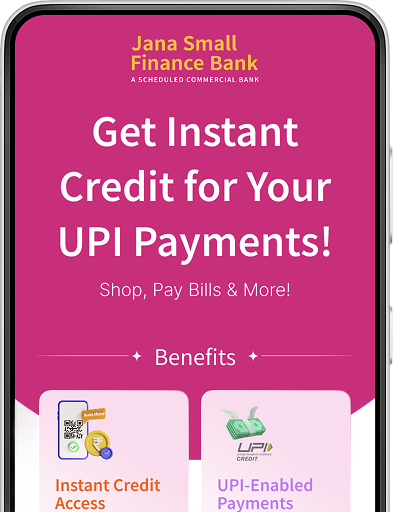
A 0→1 Credit Line on UPI experience for Jana Small Finance Bank - onboarding, KFS consent, mandate setup, repayments, and the issuer dashboard.
Overview
Credit Line on UPI lets eligible Jana Bank customers access a pre-approved credit line and use it directly through UPI. I designed the end-to-end experience across the customer journey and bank dashboard - from offer discovery and KFS acceptance to UPI mandate setup, repayments, statements, account status handling, and servicing flows. The goal was to make a complex credit product feel simple for customers, while giving the bank clear control over limits, repayments, account states, overdue cases, and support actions.
The problem
CLOU is not just an onboarding flow. It involves multiple moving parts - bank systems, Falcon, UPI switch, mandates, repayments, statements, interest, overdue logic, account blocks, and compliance checks. The challenge was to keep the user journey clean and easy, without losing the depth required for a regulated credit product.
Approach
- 01
Simplified the user journey
Broke the flow into clear steps: eligibility, offer view, KFS consent, mandate setup, UPI activation, usage, repayment, and statements.
- 02
Designed for edge cases
Covered states like mandate pending, UPI PIN pending, overdue, blocked, inactive, NPA, and closed accounts.
- 03
Made compliance easier to understand
Placed key information like due dates, MAD/TAD, AutoPay, late fees, and interest rules where users actually need them.
- 04
Built the issuer dashboard
Designed bank-facing flows for customer lookup, account details, credit limits, repayment status, statement access, account actions, and support handling.
Highlights
Decisions and tradeoffs
- •KFS consent placed after eligibility confirmation and before account creation, where drop-off was lowest.
- •The UPI mandate framed as setup rather than a permission request.
- •A dedicated screen for every account state instead of a generic status banner.
- •Tradeoff: a longer flow than a lean onboarding would want, in exchange for never dead-ending a user inside a regulated journey.
What I got wrong
My first AutoPay screen buried the consent toggle under a long explanation. Restructuring it - explanation first, the commitment statement above the fold, the toggle prominent after scrolling - passed compliance cleanly and read honestly.
Measurable impact
Business outcomes
- •Designed end to end, built by engineering
- •Demonstrated at Global Fintech Fest 2025
- •Currently in bank testing ahead of launch
Design outcomes
- •10+ account states covered end to end
- •Every external-dependency failure designed as a recovery flow
- •One prototype aligned product, engineering, compliance and the bank on a single journey
Outcome
The final prototype helped align product, engineering, compliance, and bank stakeholders on one complete journey. It gave Jana Bank a clear view of how CLOU would work across onboarding, usage, repayments, servicing, and operational edge cases - while keeping the customer experience simple and guided. Designed end to end, built by engineering, demonstrated at Global Fintech Fest, currently in bank testing ahead of launch.
CASE STUDY: JANA SFB - CREDIT LINE ON UPI (CLOU)
Credit Infrastructure · Mobile App + Issuer Portal + Bank Partner Dashboard
One-line summary
India's first scaled Credit Line on UPI deployment - a new RBI-regulated credit rail that didn't exist as a live product anywhere when I started designing it.
Problem
Credit Line on UPI was a new NPCI framework that allowed customers to spend from a pre-approved credit line directly via UPI - no card needed. Jana Small Finance Bank wanted to be one of the first issuers to go live.
There was no design precedent. NPCI defined what had to happen technically (eligibility, KFS consent, UPI mandate, TPAP linking, AutoPay) but not how it should look or feel to a user who had never heard of a credit line on UPI. The compliance surface was significant. Any one of these steps could kill onboarding completion if designed poorly.
Business and user goal
For Jana SFB: Be one of the first banks ready on CLOU, demonstrate at Global Fintech Fest, open a new credit channel. For users: Access a revolving credit line through UPI, without a physical card or branch visit.
My role
I owned the full consumer onboarding journey, in-app servicing, the issuer portal for Jana bank staff, and the bank partner dashboard.
Constraints
TPAP handoff points and switch callbacks meant flows weren't entirely under Falcon's control. KFS consent format is prescribed by RBI. I could only design how it was presented and where it appeared. Multiple external vendor dependencies meant backend failures could cause visible drop-offs. No existing user research on CLOU behaviour - too new a category.
Process
Step 1: Map the regulatory skeleton before the UX. Read the full CLOU PRD - every account status, every transition, every disclosure requirement. Step 2: Identify the highest drop-off risks: KFS consent, UPI mandate setup, AutoPay consent. Designed each as a deliberate moment that built confidence. Step 3: Design failure states as primary flows. Eligibility API failure, KFS submission failure, callback timeout, mandate setup failure - each with a specific headline, plain-language explanation, and recovery action. Step 4: Issuer portal and bank dashboard. Customer lookup, account status, mandate visibility, repayment history, delinquency actions. Step 5: Prototype for bank review and the Global Fintech Fest demo stage.
Decisions and tradeoffs
Sequence KFS consent at the right moment - after eligibility confirmation, before account creation. Drop-off was lower at this placement. Make the UPI mandate feel like setup, not permission. Account status screens for every state. CLOU has 10+ permutations - each got its own screen. Tradeoff: more screens than a lean onboarding would want, in exchange for a journey that never dead-ends inside a regulated flow.
What I got wrong
My first AutoPay setup screen had the consent toggle at the bottom of a long explanation. Restructured: explanation first, commitment statement above the fold, toggle prominent but only after scrolling. Passed compliance cleanly.
Final solution
Complete CLOU product: consumer onboarding, in-app servicing, issuer portal, bank partner dashboard, full error state coverage.
Measurable impact
Business outcomes Designed end to end and built by engineering Demonstrated at Global Fintech Fest 2025 Currently in bank testing ahead of launch
Design outcomes
10+ account states covered end to end Every external-dependency failure designed as a recovery flow, not an error screen One prototype aligned product, engineering, compliance and the bank on a single journey
What I'd improve next
The post-onboarding mandate management screens - what happens when a mandate fails, how a user re-establishes it. The active-account servicing journey deserves as much design investment as onboarding.